Blood in Urine (Haematuria)
Specialist assessment of visible and non-visible blood in the urine, at three HCA clinics in central London.

Seeing blood in your urine is alarming, but only a few drops are needed to turn a whole stream red, and the amount of blood lost is usually small. What matters is finding out why it is there. Blood in the urine can come from an infection, a stone, an enlarged prostate or, less often, from something that is better found early, so a single episode should always be checked, even if it settles on its own. Our consultants assess haematuria at three HCA clinics in London.
What haematuria means
Haematuria is the medical word for blood in the urine, and it comes in two forms. Visible haematuria (sometimes called gross or macroscopic haematuria) is blood you can see, turning the urine pink, bright red or the colour of cola. Non-visible haematuria (microscopic haematuria) cannot be seen at all and is picked up only on a urine test, often during a routine check for something else.
Seeing red urine is frightening, and most men assume they are losing a great deal of blood. In fact only a few drops are needed to colour a whole stream red, much as a splash of red cordial colours a glass of water. It looks dramatic, but the amount of blood lost is usually small.
What matters is not how much blood you can see, but why it is there. Haematuria can come from something as ordinary as a urinary tract infection, or from a kidney or bladder problem better treated early. That is why a single episode, even one that settles on its own, is worth assessing.
Symptoms that may come with it
Blood in the urine often appears on its own. When other symptoms are present, they help point towards the cause. Common ones include:
- Pink, red or cola-coloured urine
- Passing urine more often, or with more urgency
- Pain or a burning sensation when passing urine
- Pain in the lower back, flank or abdomen
- Blood clots in the urine
Painless bleeding is common, and painlessness is not reassuring in itself. Blood that appears once and then disappears still needs looking into. If you also have a poor stream or are getting up at night, see problems passing urine.
When to seek urgent help
Most haematuria can be investigated at a planned clinic appointment rather than in an emergency department, but some situations need same-day attention. Go to your nearest A&E, or call 999 if you are very unwell, when:
- you are passing heavy blood or clots, particularly if the flow is slowing or has stopped
- you cannot pass urine at all and your bladder feels full and painful — clots can block the bladder outlet, which needs treating the same day
- you have a fever, shivering or feel very unwell alongside pain in the loin or back, which can suggest a kidney infection
- you feel faint, dizzy or short of breath
- the bleeding followed a significant injury to the abdomen, back or groin
If none of that applies, ring us on +44 7889 318584, Monday to Friday, 8am to 4pm, and we will arrange an assessment. You do not need to wait for the bleeding to return before being seen.
Common causes of blood in the urine
Blood in the urine should never be ignored, but the cause is often straightforward. These are the ones we see most.
Urinary tract infection
Infection inflames the lining of the bladder or urethra, which becomes irritated and bleeds. This usually comes with burning, urgency and passing urine frequently.
Kidney or bladder stones
Hard mineral deposits can scratch the lining of the urinary tract as they move, causing bleeding. Stones may also cause severe, gripping pain in the loin or groin.
An enlarged prostate
An enlarged prostate can obstruct the flow of urine and cause bleeding from stretched, fragile blood vessels on its surface. You can read more on our page about prostate conditions.
Urethral stricture
Scar tissue narrows the urethra, restricting the flow of urine and causing bleeding within the urinary tract.
Kidney disease
Conditions affecting the kidney’s filtering units can allow blood to leak into the urine, often without any pain at all.
Bladder or kidney cancer
Abnormal growths in the urinary tract can bleed, and painless visible blood is a recognised early sign. This is not the most common cause, but it is the reason we investigate promptly rather than wait and see.
Medication
Blood-thinning medicines increase the chance of bleeding within the urinary tract. Bleeding on a blood thinner still needs investigating: the medication makes bleeding more likely, but it does not explain where the blood is coming from.
Radiotherapy
Radiotherapy to the pelvis can inflame the bladder lining, leaving it fragile and prone to bleeding, sometimes months or years after treatment.
High blood pressure
Poorly controlled blood pressure can weaken small blood vessels, allowing bleeding within the urinary tract.
Vigorous exercise
Hard exercise, particularly long-distance running, can produce urine that looks bright red or cola-coloured. It usually settles quickly, but should not simply be assumed to be the explanation.
Injury
A direct injury to the kidneys, bladder or urethra can cause blood to appear in the urine.
When the colour is not blood
Not every change in urine colour is bleeding. Eating beetroot can turn urine pink, and some food dyes and medicines do the same. Vitamin C supplements can affect the reading on a urine dipstick. None of this is a reason to assume the colour is harmless: a simple urine test settles the question, and it is better to be tested than to talk yourself out of being seen.
How haematuria is investigated
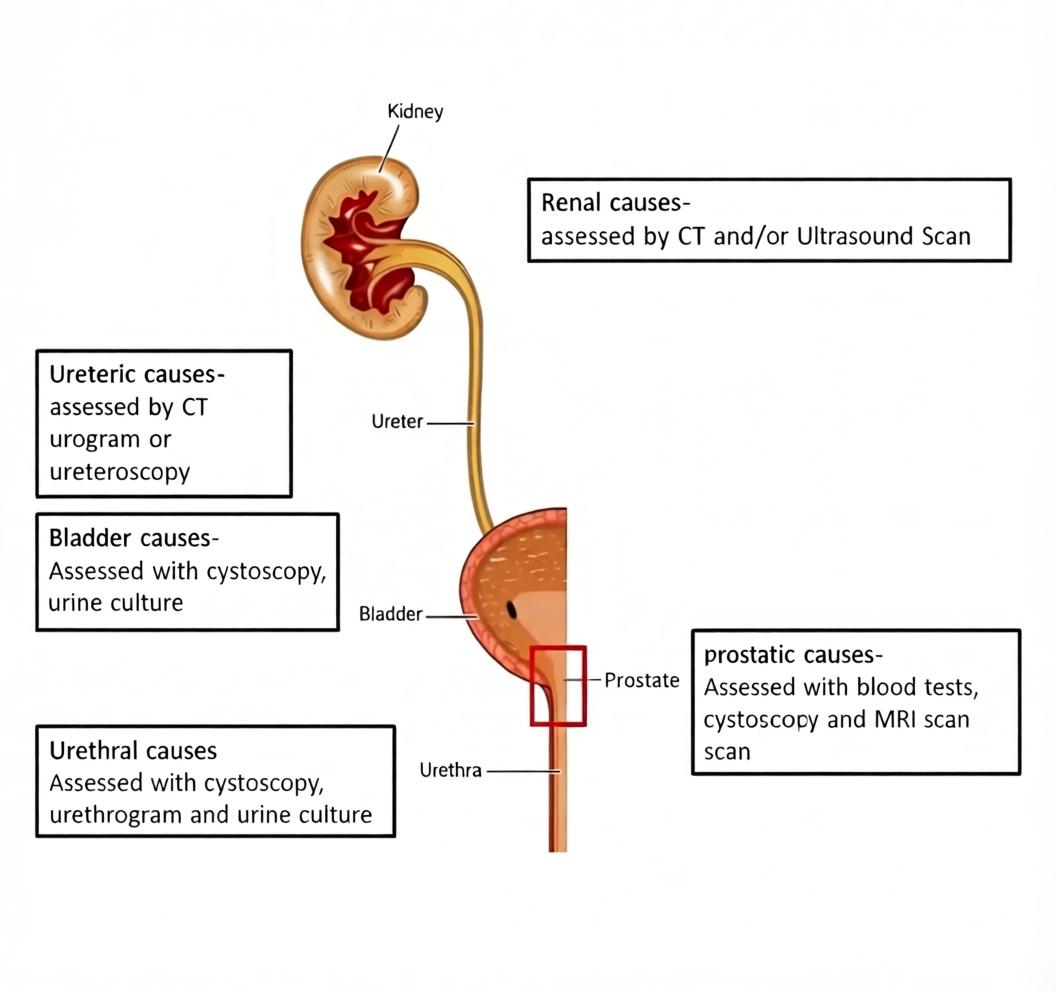
You cannot tell the cause of haematuria by looking at the urine. The assessment examines the whole urinary tract, from the kidneys down to the urethra, to identify where the blood is coming from. We match the tests to your pattern of symptoms rather than running everything as routine, so the answer comes quickly.
- Urinalysis — a dipstick and laboratory analysis of the urine to detect red blood cells, protein and signs of infection.
- Urine culture — identifies bacterial infection as a cause and shows which antibiotic would treat it.
- Blood tests — assess kidney function and look for underlying disorders. Your blood count and clotting profile show how much blood has been lost and exclude a bleeding disorder.
- Imaging — ultrasound, CT or MRI to visualise the kidneys, ureters and bladder and look for stones, tumours or structural problems.
- Cystoscopy — a small camera passed into the urethra and bladder so the lining can be inspected directly for abnormalities.
Cystoscopy is the test most men worry about. It can usually be done under local anaesthetic in the outpatient clinic, takes only a few minutes and causes some discomfort rather than pain. If more is needed, or if you are particularly anxious, it can be arranged under a general anaesthetic instead.
What happens after your results
Once the tests are complete we explain what they show in plain terms, including what has been ruled out. Where a treatable cause is found, such as an infection, a stone or an enlarged prostate, we set out the options and arrange your care. Where nothing significant is found, that is a genuine and useful result; in many cases it means monitoring rather than further tests, and we will tell you what to watch for.
If the bleeding returns after a normal set of results, contact us again. Repeat episodes are worth reporting, even when an earlier assessment was reassuring.
Seeing a specialist in London
The Andrology Centre is a specialist urology clinic in central London, covering the full range of general urology with a particular interest in men’s health. Our emphasis is rapid, targeted assessment: the tests needed to reach a diagnosis, and no more.
Your care is led by one of our three specialists, all of whom practise at Guy’s & St Thomas’, named by Newsweek in 2025 as the number one urology service in Europe. Mr Maj Shabbir is a Consultant Urological Surgeon, Clinical Lead of The Andrology Centre and a past National Chair for Andrology at BAUS. Ms Raveen Kaur Sandher is a Consultant Urological Surgeon. Ms Elsie Mensah is a Urology Specialist whose work covers bladder cancer, benign prostatic enlargement and prostate diagnostics.
We consult at HCA at The Shard (SE1 9BS), HCA at Canary Wharf (E14 5NR) and HCA at Guy’s Hospital (SE1 9RT). If you are paying for your own care you do not need a GP referral and can book directly. If you plan to use private medical insurance, your insurer will usually require a referral first, so check with them before booking.
To arrange an appointment, call +44 7889 318584 between 8am and 4pm, Monday to Friday, email contact@theandrologycentre.co.uk, or use our contact page. Tell us you have seen blood in your urine when you get in touch, and we will prioritise your appointment.
Frequently asked questions
Is blood in urine always serious?
No. Infections and stones are common explanations, and many men turn out to have nothing serious. But you cannot tell the cause from the colour, and painless bleeding can be the first sign of a bladder or kidney problem. A single episode, even one that settles by itself, should be assessed rather than ignored.
Can haematuria be painless?
Yes, and painless bleeding is common. The absence of pain does not mean the cause is minor; painless visible blood is the pattern that most warrants prompt investigation. Do not wait to see whether it happens again before arranging an assessment. If the bleeding is heavy, or you cannot pass urine at all, seek same-day medical help.
Are the tests painful?
Most are not. Urine tests, blood tests and imaging such as ultrasound, CT or MRI are painless. Cystoscopy, in which a small camera inspects the bladder lining, is usually done under local anaesthetic in the outpatient clinic and takes only a few minutes; it causes some discomfort rather than pain. If more is needed, or you are very anxious, it can be arranged under a general anaesthetic.
Will my insurance cover the investigations?
Most insurers cover the investigations needed to find the cause of haematuria, but policies differ, so check yours before booking. Insurers usually require a GP referral first. If you are funding your own care you do not need a referral and can book directly with us.
Do I still need investigating if the bleeding has stopped?
Yes. Bleeding that stops on its own does not mean the cause has gone; many causes bleed intermittently. A full assessment of the urinary tract is the only way to know what produced it. When you come, bring details of any medication you take, including blood thinners, and tell us whether the blood was visible or found on a test.
What does non-visible haematuria mean if I feel well?
It means blood was found on a urine test but is invisible to the eye, often discovered during a check for something else. Feeling well is usual and does not rule out a cause worth finding. Non-visible haematuria is generally investigated less urgently than visible bleeding, but it should still be assessed, including your blood pressure and kidney function.
References and further reading
- NHS. Blood in urine. www.nhs.uk/conditions/blood-in-urine
- British Association of Urological Surgeons (BAUS). Patient information. www.baus.org.uk/patients
- European Association of Urology (EAU). Guidelines. uroweb.org/guidelines
External links open in a new window. The Andrology Centre is not responsible for the content of external websites.
Speak to a specialist in confidence
Most men wait far longer than they need to. A single consultation is often enough to identify the cause and set out your options.