Problems Passing Urine
Specialist assessment and treatment for a weak stream, difficulty starting, frequency at night and incomplete emptying, at our London clinics.
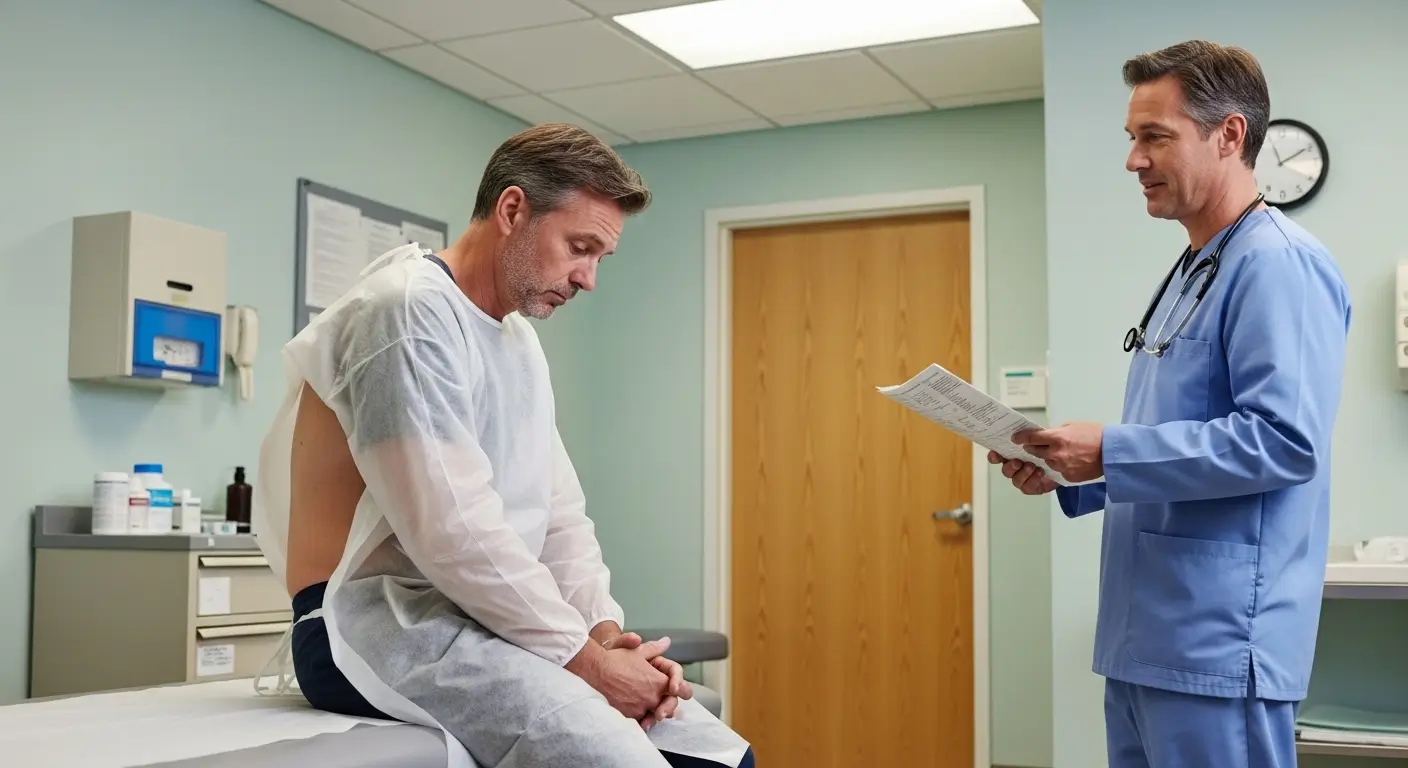
Difficulty passing urine is one of the most common reasons men come to see us, and one of the most commonly ignored. A weaker stream, waiting for it to start, getting up at night, or the feeling that the bladder has not quite emptied are all worth having looked at, because the cause is usually identifiable and often treatable. This page explains what the symptoms tend to mean, the tests we use to work out where the problem lies, and every treatment option we offer — including the ones that involve doing nothing yet.
What problems passing urine feel like
Difficulty passing urine is common in men and usually comes on slowly enough to be easy to explain away. Many men adapt around it for years — planning journeys around toilets, getting up twice a night — before mentioning it. Most causes are not dangerous and many are straightforward to treat, but the pattern of your symptoms tells us a great deal about where the problem lies.
Symptoms usually fall into four groups.
- Urinary — a weak or slow stream, difficulty starting or stopping, passing urine often (especially at night), the feeling of not emptying fully, or a sudden urge to go.
- Physical — lower abdominal or pelvic discomfort, burning or pain on passing urine, and lower back pain.
- Sexual — painful ejaculation, reduced sexual desire and erectile difficulties, which often sit alongside urinary symptoms rather than apart from them.
- Warning signs — blood in the urine (haematuria), a sudden inability to pass urine at all, and severe or worsening pain.
Not every symptom needs treatment. If your flow is a little slower than it was ten years ago but you sleep through the night and empty comfortably, monitoring with periodic review is reasonable and often right. Treatment becomes worth considering when symptoms disrupt sleep, work or travel, when the bladder is not emptying, or when tests suggest the bladder or kidneys are under strain.
When to seek urgent care
Some symptoms should not wait for a routine appointment. Seek same-day help from NHS 111, your GP or an emergency department if you suddenly cannot pass urine despite a full and painful bladder, if you pass visible blood in your urine, or if you have a fever with shivering, flank pain and pain on passing urine. A bladder that cannot empty needs a catheter to relieve it and is not something to sit out overnight. Visible blood always needs investigating, even when it happens once and clears on its own — see our blood in urine page.
What causes problems passing urine
The common causes are:
- Enlarged prostate (BPH) — the prostate grows with age and can obstruct the flow of urine through it.
- Urinary tract infection (UTI) — causing pain, urgency and frequency.
- Prostate infection or inflammation (prostatitis) — causing pelvic discomfort along with urinary symptoms.
- Urethral stricture — a narrowing of the urethra that slows the stream and makes the bladder work harder.
Obstruction is the most common explanation, but not the only one. Some men have difficulty because of how the bladder itself behaves — one that does not contract well, or an overactive one driving urgency and frequency. This matters because the treatments are entirely different, and operating on a prostate that was never the problem will not help. A proper assessment separates the two first.
How we find the cause
We work through the tests in stages, starting with the simplest and going further only when the answer is not clear.
- Consultation and examination — a detailed discussion of symptoms and examination of the prostate.
- Urine and blood tests — to detect infection and check kidney function, PSA and other markers.
- Uroflowmetry — measures the speed and volume of your urine flow.
- Flexible cystoscopy — a small camera passed into the urethra and bladder to inspect them.
- Ultrasound or MRI — to visualise the bladder, prostate and kidneys.
- Urethrogram — an X-ray study to assess the length and position of any urethral stricture.
- Video urodynamics — in selected cases, to measure bladder function and pinpoint the obstruction.
Treatment options
We aim for early detection, accurate diagnosis and a personalised plan, so treatment is matched to the cause rather than the symptom.
Medication
- Alpha-blockers — relax the muscle within the prostate to improve flow and ease difficulty passing urine.
- Antibiotics — to treat prostatitis and urinary tract infections.
- Other medications — to reduce inflammation, shrink the prostate or relieve blockage. Where the bladder rather than the prostate is at fault, medication can also help urgency, frequency and nocturia (getting up at night to pass urine).
Minimally invasive procedures
- Endoscopic treatment of strictures — dilatation, urethrotomy or the Optilume drug-coated balloon, which widen a narrowed urethra.
- Endoscopic treatment of the enlarged prostate — Urolift and Rezum, both available under local anaesthetic, for enlargement that is blocking flow.
Surgery
- Urethral reconstruction (urethroplasty) — the definitive treatment for complex or recurrent strictures, rebuilding the urethra, often with a graft.
- Surgical removal of enlarged prostate tissue — TURP, bladder neck incision (BNI), HoLEP or Aqua-ablation, to restore a normal channel and normal flow.
Surgical procedures for problems passing urine at a glance — a side-by-side comparison of the treatments, what each does, and their trade-offs.
Comparing the treatments we offer
There is rarely one correct answer. The right procedure depends on the size of your prostate or the length of your stricture, whether you have been treated before, and how much weight you place on preserving ejaculation. The summary below is a starting point for that conversation, not a replacement for it.
For urethral strictures
- Dilatation or optical urethrotomy — a quick day case that stretches or incises the narrowing, with a catheter usually for two to three days. Effective in up to half of cases, but much less so for strictures that have already recurred.
- Optilume — a drug-coated balloon that widens the stricture and helps hold it open for longer. Also a day case with a catheter for two to three days, with around 70% still open at three years, including recurrent strictures. It is a relatively new device, so long-term data are limited, and contraception is needed for six months afterwards.
- Urethroplasty — reconstruction of the narrowed segment, often using a graft. The most durable option, with long-term success of roughly 85–90% beyond ten years, but a larger open operation taking three to four hours, with an overnight stay and a catheter for about two weeks.
For an enlarged prostate
- Urolift — pins the prostate tissue back rather than removing it. A quick day case, often under local anaesthetic and frequently with no catheter afterwards, with a better chance of preserving ejaculation. Not suitable for larger prostates, and about one man in ten needs further prostate treatment within three years.
- Rezum — uses steam to shrink prostate tissue. A day case, again possible under local anaesthetic, with a similar advantage for ejaculation and more durable results than Urolift. Not suitable for larger prostates, needs a catheter for three to five days, and the benefit only appears as the prostate shrinks over two to four weeks. Frequency, urgency and burning often increase first.
- TURP or bladder neck incision (BNI) — resection of the prostate or bladder neck to open a wider channel. The traditional standard, with a one to two day stay and a catheter afterwards. Ejaculation usually becomes ‘dry’, and 10–20% of men need a further operation after five to ten years.
- HoLEP — laser enucleation of the whole gland. Removes more tissue than TURP and lasts longer, with less bleeding and a shorter stay, and suits larger prostates particularly well. Ejaculation usually becomes dry, and temporary burning and urgency are more common early on than after TURP.
- Aqua-ablation — a robot-assisted, heat-free waterjet that removes prostate tissue. It preserves ejaculation better than other procedures that resect the prostate and suits all prostate sizes. Newer, so results beyond ten years are less clear, with a higher risk of early bleeding, urgency and burning.
Most men return to passing urine normally within a few weeks to a couple of months, depending on the procedure. We will tell you beforehand what recovery realistically looks like, including the effect on ejaculation — most men would rather hear that plainly than discover it later.
Appointments, clinics and referrals
The Andrology Centre’s three specialists all practise at Guy’s & St Thomas’, named by Newsweek in 2025 as the number one urology service in Europe. Mr Maj Shabbir, Consultant Urological Surgeon, is Clinical Lead of The Andrology Centre and a past National Chair for Andrology at BAUS. Ms Raveen Kaur Sandher is a Consultant Urological Surgeon. Ms Elsie Mensah is a Urology Specialist with a focus on bladder cancer, BPH and prostate diagnostics.
We see patients at HCA at The Shard (SE1 9BS), HCA at Canary Wharf (E14 5NR) and HCA at Guy’s Hospital (SE1 9RT). If you are paying for your own care you do not need a GP referral. If you are using private medical insurance, your insurer will usually require one, so check with them before booking.
To arrange a consultation, call +44 7889 318584 — lines are open Monday to Friday, 8am to 4pm — or email contact@theandrologycentre.co.uk. You can also use our contact page or read about related prostate conditions.
Frequently asked questions
Are all problems passing urine caused by an obstruction?
No. Obstruction from the prostate or a narrowing in the urethra is the most common cause, but some men have difficulty because the bladder itself is not working as it should. That distinction changes the treatment completely, which is why we assess bladder function as well as the prostate before recommending anything. A full assessment pinpoints the cause and points to the most suitable option for you.
My problem was a urine infection. Are antibiotics all I need?
Antibiotics will usually clear the infection itself, but they are not the end of it. A man should not really have even a single urinary tract infection, and having one is a sign of a possible underlying problem — obstruction, incomplete emptying or a stricture — that needs investigating and treating to prevent further episodes. We would recommend assessment after the infection has settled.
Can medication improve my urine flow?
Often, yes. Alpha-blockers and other medicines can relieve obstruction and improve symptoms in many men, and are usually the first thing tried before any procedure is considered. Where the bladder rather than the prostate is the problem, a different group of medications can help with urgency, frequency and nocturia. Which one suits you depends on what the tests show.
My problem is prostatitis. What can be done?
There are several options, depending on whether infection is still active. They range from longer courses of antibiotics, through medical treatments aimed at the symptoms of inflammation, to pelvic floor physiotherapy. Prostatitis can take patience to settle, and it often responds better to a combination of measures than to one alone. Our specialists will guide you through the sequence.
How long does recovery take after a prostate procedure?
Most men return to passing urine normally within a few weeks to a couple of months, though it varies with the procedure. Some are day cases with no catheter at all; others need a catheter for several days and a short hospital stay. With Rezum in particular, the benefit only appears once the prostate shrinks over two to four weeks.
Do I need a GP referral to be seen?
If you are funding your own care, no referral is needed — you can contact us directly. If you are using private medical insurance, your insurer will usually require a GP referral before they authorise the consultation, so it is worth checking their requirements first. Call +44 7889 318584 between 8am and 4pm, Monday to Friday, and we will help you arrange it.
References and further reading
- NHS. Benign prostate enlargement. www.nhs.uk/conditions/prostate-enlargement
- NHS. Urinary incontinence. www.nhs.uk/conditions/urinary-incontinence
- British Association of Urological Surgeons (BAUS). Patient information. www.baus.org.uk/patients
- European Association of Urology (EAU). Guidelines. uroweb.org/guidelines
External links open in a new window. The Andrology Centre is not responsible for the content of external websites.
Speak to a specialist in confidence
Most men wait far longer than they need to. A single consultation is often enough to identify the cause and set out your options.